A few years ago, businesses evaluating a CRM asked questions such as:
• Can it manage leads?
• Can it automate follow-ups?
• Can it track the sales pipeline?
• Can it generate reports?
Today, another question has entered the discussion:
Should we choose Zoho CRM or move to an AI Powered CRM?
There is one problem with that question.
Zoho CRM itself is becoming an AI Powered CRM.
With Zia, predictive intelligence, generative AI, recommendations, forecasting and AI agents, the choice for growing businesses is no longer simply traditional CRM vs AI CRM.
The better question is:
How much AI does your business actually need, and how should it work within your sales process?
Key Takeaways
• Zoho CRM is no longer just a traditional CRM platform it now includes AI-powered capabilities such as predictive lead scoring, forecasting, workflow recommendations, generative AI, and AI agents through Zia.
• For most growing businesses, the real decision is not Zoho CRM vs AI Powered CRM, but rather how much AI should be integrated into the CRM to support business goals.
• AI delivers the most value when it helps businesses prioritize leads, improve forecasting, automate repetitive tasks, identify sales opportunities, and enhance decision-making.
• Businesses should first establish structured sales processes, centralized customer data, and workflow automation before implementing advanced AI capabilities.
• Zoho CRM is an excellent choice for businesses dealing with multiple lead sources, inconsistent follow-ups, limited pipeline visibility, and increasing operational complexity.
• Native Zoho AI features may be sufficient for many organizations, while businesses with unique workflows, ERP integrations, or industry-specific requirements may benefit from additional AI integration services.
• Successful AI adoption is not about adding more tools; it is about improving business processes and introducing AI where it creates measurable business value.
• Working with an experienced Zoho Consultant helps businesses determine what should remain manual, what can be automated, and where AI can generate the highest return on investment.
• As a Zoho Premium Partner, Absoft helps businesses implement, customize, automate, and integrate Zoho CRM while identifying practical opportunities for AI adoption and digital transformation.
• The most successful organizations will be those that combine clean data, optimized processes, automation, AI, and human expertise into a unified CRM ecosystem that can scale with business growth.
What Is an AI Powered CRM?
An AI Powered CRM combines traditional customer relationship management with artificial intelligence to help businesses do more than record customer activity.
Traditional CRM systems primarily help teams capture and organize information.
AI can help businesses interpret that information and decide what deserves attention.
Depending on the platform and configuration, an AI Powered CRM may help with:
• Lead scoring and prioritization
• Sales forecasting
• Customer churn prediction
• Recommended next actions
• Email generation and summarization
• Customer sentiment analysis
• Anomaly detection
• Automated data enrichment
• Sales-agent assistance
• AI agents performing specific repetitive tasks
The movement towards AI inside CRM is not theoretical. Gartner's latest research on CRM Sales Platforms notes that CRM vendors are increasingly focusing on generative AI and agentic AI capabilities.
But having more AI features does not automatically mean having a better CRM.
Is Zoho CRM Already an AI Powered CRM?
Increasingly, yes.
Zoho CRM includes its AI assistant, Zia, across several areas of sales and customer management.
Current Zoho capabilities include predictive scoring, churn prediction, forecasting, recommendations, anomaly detection, workflow suggestions, generative AI and AI agents.
For example, a sales team could potentially use AI to identify which opportunities deserve immediate attention instead of asking every salesperson to manually review hundreds of leads.
Managers can identify unusual changes in sales activity.
Teams can generate summaries or content using CRM context.
AI agents can increasingly take over defined repetitive activities while salespeople concentrate on conversations requiring human judgement.
Businesses wanting a deeper understanding of the platform can explore Absoft's guide to Zoho CRM features and functions.
The important distinction is that AI is becoming a capability within the CRM rather than a separate category of software.
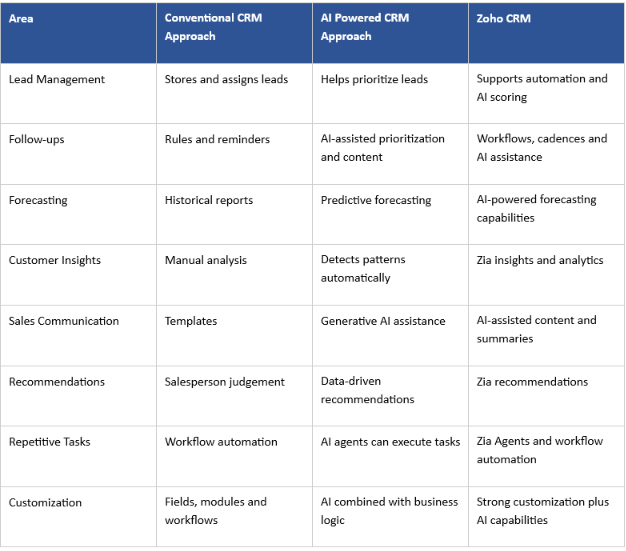
Zoho CRM vs AI Powered CRM: The Real Comparison
The practical takeaway is simple.
Growing businesses may not need to replace Zoho CRM to get AI. They may need to implement Zoho CRM more intelligently.
Where AI Can Actually Improve Sales
AI becomes valuable when it solves a measurable operational problem.
Consider a business receiving 2,000 enquiries every month.
The challenge may not be capturing those leads. The challenge could be deciding:
Which 100 deserve immediate attention?
Or consider a sales manager reviewing 300 active opportunities.
Instead of manually going through every deal, AI could help identify unusual inactivity, potential churn or opportunities requiring intervention.
McKinsey's research into how B2B sales leaders are using technology and AI highlights areas such as AI-powered opportunity identification and greater personalization of sales interactions.
That is significantly more valuable than introducing AI simply because it is the latest technology trend.
When Zoho CRM Makes Sense for a Growing Business
Zoho CRM can be particularly relevant when a business needs to create structure around a growing sales operation.
Common situations include:
1. Leads Are Coming From Multiple Sources
Website enquiries, Meta Ads, Google Ads, IndiaMART, WhatsApp, referrals and offline sources can create fragmented customer data.
A properly configured CRM can bring these leads into a structured pipeline.
2. Follow-ups Depend on Individual Salespeople
If lead conversion depends on someone remembering to make the next call, the sales process becomes difficult to scale.
This is where workflow automation becomes important. Absoft has outlined several common CRM automation gaps that can cause businesses to lose opportunities.
3. Management Lacks Pipeline Visibility
Business owners should not have to ask every salesperson:
"What is happening with this lead?"
A configured CRM should make pipeline movement, ageing, activities and performance visible.
4. Your Processes Are Becoming More Complex
Multiple products, territories, approval levels, teams or customer journeys often require greater CRM customization.
5. You Want AI Without Building an Entire AI Stack
This could become one of Zoho CRM's biggest advantages for growing businesses.
Instead of assembling separate tools for CRM, predictive analytics, generative AI and sales automation, businesses can evaluate which AI capabilities can operate within their existing CRM ecosystem.
Our consultants can assess your current CRM setup and recommend the right level of automation and AI for your business.
Not Sure How Much AI Your Zoho CRM Actually Needs?When Should You Consider Additional AI Integration?
Zoho's native AI capabilities will not necessarily cover every business requirement.
A company may require AI to interact with proprietary databases, internal applications, documents, voice systems, ERP platforms or industry-specific processes.
For example:
CRM receives an enquiry → AI reads the requirement → classifies the opportunity → checks internal information → prepares a response → CRM assigns the opportunity → salesperson reviews and approves the next action.
That is no longer just CRM configuration.
It is a connected AI-enabled business workflow.
Absoft's AI Integration Services focus on embedding AI into existing business systems rather than forcing teams to adopt another disconnected application.
The Biggest Mistake: Buying AI Before Fixing the Process
Imagine your existing sales process looks like this:
Lead arrives → nobody owns it → salesperson calls whenever possible → notes are incomplete → follow-up gets missed → manager asks for an Excel report.
Adding AI to this process will not magically solve it.
You first need to define:
Lead Capture → Qualification → Ownership → Follow-up → Opportunity → Proposal → Closure → Customer
Then determine where automation or AI can improve each stage.
This is why successful Zoho CRM implementation should begin with process mapping rather than software configuration.
AI should accelerate a good process, not automate a broken one.
Do You Need a Zoho Consultant in the AI Era?
Possibly more than before.
Previously, a Zoho Consultant primarily helped businesses configure modules, workflows, fields, dashboards and integrations.
The role is evolving.
Businesses now need to decide:
• What should remain manual?
• What should use conventional automation?
• Where can predictive AI add value?
• Where could generative AI improve productivity?
• Which activities could eventually be performed by AI agents?
• Where should human approval remain mandatory?
• How should CRM and external AI systems exchange data securely?
The technology is only one part of the decision.
A good Zoho Consultant should therefore understand the business workflow before recommending the automation.
So, What Should Growing Businesses Choose?
For most growing businesses, the choice should not be:
Zoho CRM OR AI Powered CRM.
It should be:
A properly implemented CRM with the right level of AI.
Start with the business problem.
Build the sales process.
Centralize reliable customer data.
Automate predictable activities.
Then introduce AI wherever it can improve prioritization, productivity, personalization or decision-making.
Zoho CRM can provide the foundation while native Zia capabilities and additional AI integrations extend what that system can do.
That approach is often more practical than abandoning an established CRM simply to buy something carrying the latest AI label.
Build a CRM That Is Ready for AI
The future of CRM is clearly becoming more intelligent.
But the businesses that gain the most from AI will not necessarily be those with the largest number of AI features.
They will be the businesses that connect clean data, clear processes, automation, AI and human judgement into one operating system.
Absoft helps businesses implement, customize and integrate Zoho CRM while identifying where automation and AI can create practical business value.
Whether you are evaluating Zoho CRM, upgrading an existing implementation or exploring AI inside your sales process, start by understanding what your business actually needs.
FAQs
1. How can Absoft help my business choose between Zoho CRM and an AI Powered CRM?
Absoft analyzes your sales process, customer journey, reporting requirements, and automation goals to recommend the most suitable CRM strategy. In many cases, businesses can achieve their AI objectives through Zoho CRM implementation and AI enhancements without switching to an entirely new platform.
2. Does Absoft provide Zoho CRM implementation and customization services?
Yes. Absoft offers end-to-end Zoho CRM implementation, customization, workflow automation, dashboard development, user training, and ongoing support to ensure the CRM aligns with your business processes.
3. Can Absoft integrate AI into our existing Zoho CRM?
Absolutely. Absoft helps businesses leverage Zoho's native AI capabilities while also integrating advanced AI solutions, AI agents, predictive analytics, and custom automation workflows tailored to specific operational needs.
4. What AI-powered CRM services does Absoft offer?
Our services include AI-powered lead scoring, intelligent workflow automation, AI chatbot integration, predictive sales forecasting, customer journey automation, CRM data enrichment, and custom AI integrations with ERP and third-party systems.
5. Can Absoft migrate our data from another CRM to Zoho CRM?
Yes. We provide secure CRM migration services from Salesforce, HubSpot, Microsoft Dynamics, Pipedrive, and other platforms while ensuring data accuracy, minimal downtime, and seamless business continuity.
6. How does Absoft identify the right level of AI for a business?
Our consultants conduct a detailed process audit to identify bottlenecks, repetitive tasks, lead management gaps, and reporting challenges. Based on these findings, we recommend practical AI use cases that deliver measurable ROI instead of unnecessary complexity.
7. Why should businesses work with a Zoho Consultant before implementing AI?
AI is most effective when built on structured business processes. Absoft's Zoho Consultants first optimize CRM workflows, data management, and automation before introducing AI, ensuring long-term scalability and higher user adoption.
8. Can Absoft automate lead management and sales follow-ups in Zoho CRM?
Yes. We configure lead capture, lead assignment, automated follow-ups, sales cadences, approval workflows, notifications, and AI-assisted lead prioritization to help businesses improve response times and conversion rates.
9. Can Absoft integrate Zoho CRM with ERP, WhatsApp, websites, and third-party applications?
Absolutely. Absoft specializes in API integrations and can connect Zoho CRM with ERP systems, WhatsApp, telephony platforms, websites, payment gateways, marketing tools, and custom business applications to create a unified ecosystem.
10. Why choose Absoft as your Zoho CRM and AI implementation partner?
As a Zoho Premium Partner, Absoft focuses on business process automation, CRM optimization, AI integration, and digital transformation. Our process-first approach ensures technology is implemented to solve real business challenges and support sustainable growth.
Talk to Absoft about your CRM and AI requirements. we'll help you assess what your business actually needs.
Ready to Build the Right Level of AI Into Your CRM?