At a glance
- Zoho products
- Zoho CRM, Zoho SalesIQ, Zoho Forms
- Industry
- Consumer goods — beverages, sold through distribution, retail and quick commerce
- Channel network
- Retailers, distributors, super stockists, wholesalers, exporters, trade partners, ecommerce and quick commerce
- Custom & integration work
- Multi-channel capture across web, social, WhatsApp, chat and email; an enquiry classification tree with automated qualifying questions and replies; team routing; SLA reminders and escalation; event lead capture by QR; website visitor tracking with Google Analytics
- Internal teams served
- Sales, marketing, HR, finance, operations, warehouse, logistics and admin
Real enquiries getting lost in your social inbox? There's a system for that. Get a free automation audit
The Challenge
The brand was visible and growing. Visibility is what created the problem.
- Eight front doors, no doorman. Website contact forms, promoted landing pages, Instagram, Facebook, WhatsApp, the website chat widget, email and standalone forms. Each one had somebody watching it occasionally. None of them fed a shared queue, so nobody could say how many enquiries had arrived that week or what happened to them.
- Six completely different kinds of enquiry, one inbox. Distributors wanting territory, students asking for internships, colleges pitching sponsorships, vendors selling services, investors reaching out, customers complaining about a bottle — plus a steady volume of "hi", emoji replies and follow-for-follow. All handled by the same overloaded person.
- The valuable one looked exactly like the rest. A retailer asking to stock the product is a revenue event. In a social inbox it looks identical to everything else, and it goes unanswered for days while somebody works through the noise.
- No response standard, and no way to enforce one. Different channels had different implied urgency and nothing measured any of it. An enquiry forwarded to a team either got answered or quietly didn't, and nobody found out which.
- Events produced leads nobody could trace. Exhibitions and trade events generated real interest with no mechanism to capture it at the stall or attribute it afterwards.
What We Built
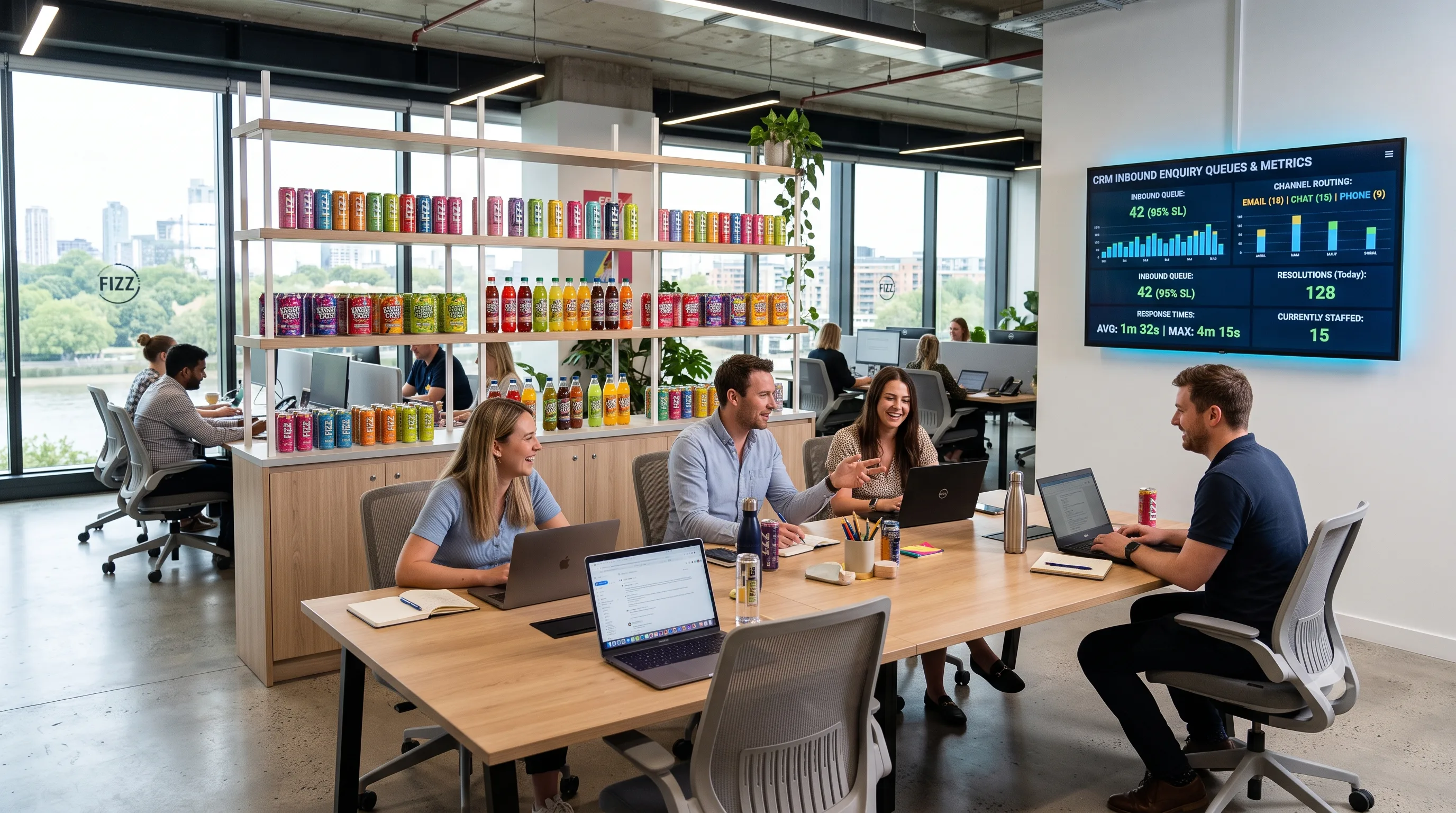
A classification and routing layer on Zoho, sitting in front of the teams. Zoho CRM holds the record and SalesIQ handles the conversation. The design work is the decision tree — what each enquiry type is, what question qualifies it, who it goes to, and what the sender hears back while they wait.
Every channel into one queue
- Website contact forms, promoted landing pages, Instagram, Facebook, WhatsApp, the SalesIQ chat widget, email and Zoho Forms all feeding a single enquiry stream, tagged by source.
- QR codes at exhibitions and events opening a capture form that lands straight in the CRM, so a conversation at a stall becomes a record before the person walks away.
- Website visitor tracking with Google Analytics, set up specifically to measure whether event and exhibition spend actually produced traffic.
The sorting layer
- Every enquiry classified into one of five types — channel partnership, collaboration, job, complaint, or other — and routed to sales, marketing, HR or admin accordingly.
- Qualifying questions built into the automated flow rather than left to the first human. A partnership enquiry is asked for phone number and pincode immediately, because a distributor enquiry without a pincode can't be routed to a territory and becomes a phone call nobody makes.
- A collaboration enquiry is asked the question that decides it — whether it's a barter arrangement — and routed or declined on the answer.
- Explicit non-response rules: greetings, emoji replies and follow-for-follow messages are identified and left alone, deliberately, so they never enter the queue or the reporting.
Everyone hears something back
- An automated acknowledgement on every real enquiry naming the team that will pick it up, so the sender knows they've been seen rather than wondering for three days.
- Automated declines, written warmly, for collaborations the brand isn't taking this cycle. Most brands leave those unanswered, which costs goodwill and earns nothing.
- Channel-aware response targets, with priority set per channel across email, WhatsApp, SMS and call.
Complaints handled like a food business should
- Complaints classified on arrival by type — taste, quality, price, packaging, bottle or can.
- The first automated reply asks for a photograph of the manufacturing details on the pack, so the batch is identified before a human opens the ticket rather than three exchanges later.
- The ticket then routes to the responsible team with the evidence already attached.
An escalation ladder that actually fires
- Ticket raised to the owning team, with a six-hour window before an automatic reminder.
- At eight hours, an escalation email goes up the chain.
- Resolution closes the ticket into a closed-ticket record, so response performance is reportable rather than anecdotal.
Results
- One queue, eight channels. Every enquiry arrives tagged by source and enquiry type instead of sitting in whichever inbox it landed in.
- The revenue enquiries surface. A partnership request is identified, qualified with a pincode, and in front of sales rather than buried under fan mail.
- Nobody is ignored. Automated acknowledgements on every real enquiry, and automated declines on the ones the brand isn't taking.
- Complaints arrive with their batch evidence attached.
- Unanswered tickets escalate on a clock, at six hours and again at eight.
- Event spend is traceable through QR capture and site visitor tracking.
Why It Worked
We started from the opposite assumption to most CRM projects: most of this inbound isn't a lead.
The standard approach is to capture everything into the CRM and let the sales team sort it. For a consumer brand with an active social presence that is how you drown a team and train them to stop checking. The volume is real but the value is concentrated in a small fraction of it, and the job of the system is to find that fraction before a human spends attention on the rest. Sorting was the product here. Capture was the easy part.
The decision we'd point to is asking for the pincode in the first automated message. It sounds trivial. A distributor enquiry without a pincode cannot be routed to a territory, which means it becomes a follow-up call somebody has to remember to make, which means half of them never happen. Moving one question from the third human touch to the first automated one is the difference between an enquiry and an opportunity. Giving every lead an owner the moment it lands did the same job for a multi-location retail brand.
We also wrote down what not to answer. "Hi", emojis, follow-for-follow — explicitly excluded, by rule, so they never enter the queue or distort the response-time reporting. Most specifications never say what the system should ignore, and then everyone wonders why the metrics look wrong.
And the automated decline was worth building. A college pitching a sponsorship the brand won't take still gets a warm, prompt no. It earns no revenue and it costs almost nothing, and it is the difference between a brand that feels responsive and one that feels like it doesn't read its messages.
Frequently asked questions
Can Instagram and Facebook messages be routed into Zoho CRM?
Yes, through Zoho's social and messaging integrations, with each message tagged by source. The harder question is what you do with them once they arrive — for most consumer brands the majority are not enquiries at all, so classification matters more than capture.
How do you stop real enquiries getting lost in a social inbox?
By classifying before a human looks. Route by enquiry type, ask the one qualifying question automatically, and put the result in front of the right team. If your process depends on someone reading every DM carefully, it will fail on the day you go viral.
What should the first automated reply ask for?
Whatever the next step cannot happen without. For a distribution enquiry that's phone number and pincode. Teams usually collect this on the second or third touch, and that's where most enquiries die. Move it to the first message.
Can we capture leads at exhibitions and events?
A QR code at the stall opening a form that writes into the CRM does it, and pairs with website visitor tracking so you can see whether the event produced traffic as well as conversations. It's the cheapest attribution available to a brand doing trade shows.
Can customer complaints be handled in the same system?
Yes, and for food and beverage they should be. Classify the complaint type on arrival and ask for a photo of the manufacturing details in the automatic acknowledgement — you get batch traceability before a human opens the ticket instead of after three exchanges.
How do you make an SLA real rather than aspirational?
Put a clock on it with two steps. A reminder to the owner at one threshold, an escalation up the chain at the next. Here that was six hours and eight. An SLA with no escalation attached is a number in a document.
Do we need Zoho CRM, or is a smaller tool enough?
Depends on the channel network. If you sell through distributors, stockists and retailers, you need the account structure and territory routing that full CRM gives you. A lighter tool is fine if your sales motion is simple and stays simple — we'll tell you which one you are rather than selling you the bigger licence by default.
Facing the same challenge?
If your real enquiries are getting lost among the noise in your inbox, we'll show you what a sorting layer looks like for your brand. Start with a free automation audit. Get a free automation audit